Introduction
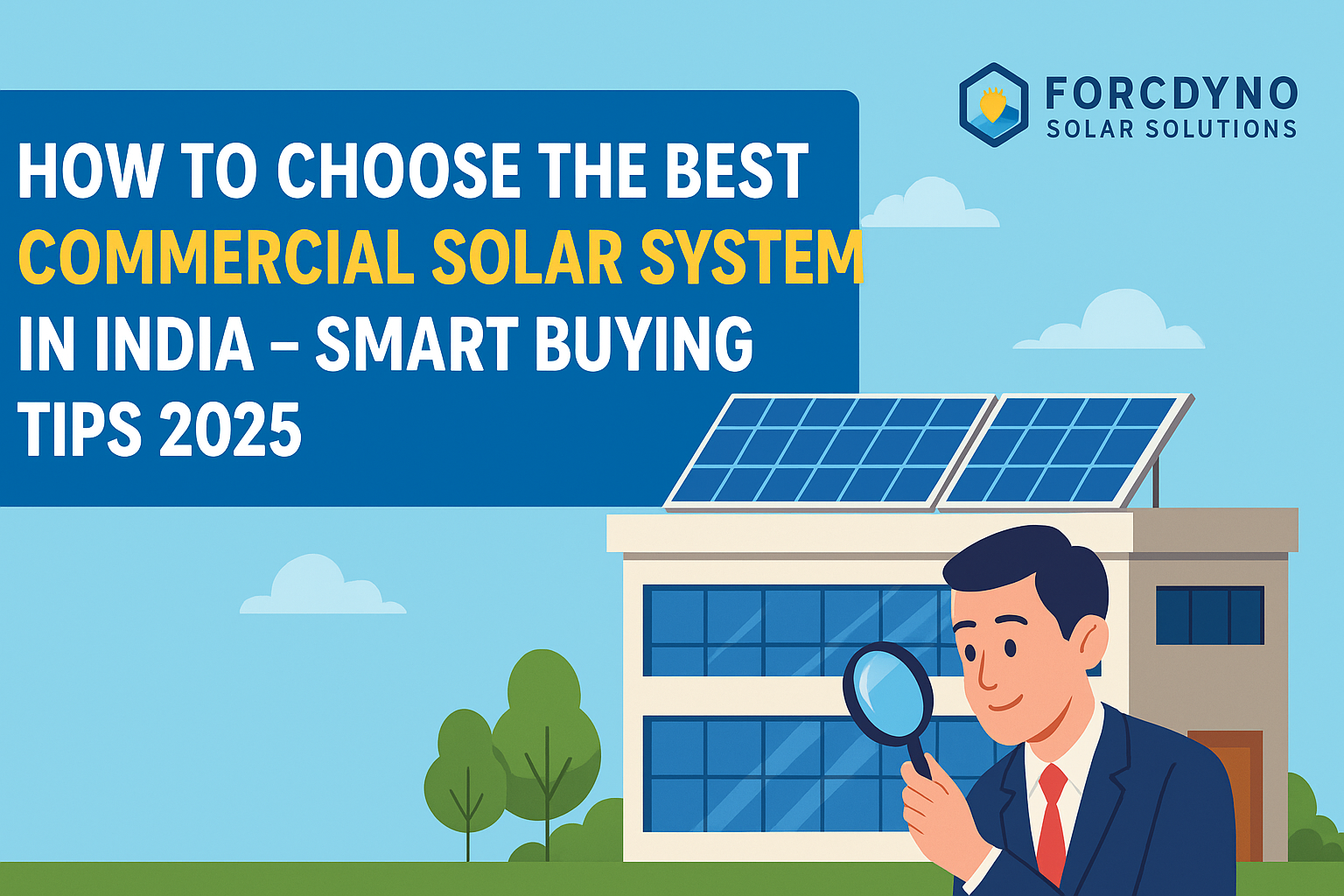
Switching to solar isn’t just a green move anymore — it’s a smart business decision.
With rising electricity costs and government incentives, Indian businesses are now turning towards commercial solar systems to reduce energy expenses and boost sustainability.
But here’s the truth — not every solar system fits every business. Choosing the best commercial solar system in India requires more than just comparing prices. You need to evaluate quality, ROI, maintenance, and the credibility of your solar partner.
This guide will help you make an informed decision, step by step — in a simple, direct, and practical way.
Understand What a Commercial Solar System Really Is
A commercial solar system is a large-scale setup designed to meet the power demands of offices, factories, warehouses, institutions, or retail spaces.
It usually includes:
- Solar Panels (monocrystalline or polycrystalline)
- Inverters
- Mounting Structures
- Cables & Junction Boxes
- Battery (optional)
- Monitoring System
These systems are connected to your existing electrical network — and can be either on-grid, off-grid, or hybrid depending on your business type.
Pro Tip: For most industries, on-grid systems are ideal because they allow you to export extra power back to the grid and save on monthly bills.
Analyze Your Power Requirement
Before you buy any solar panel system, you need to know how much energy your business actually consumes.
Here’s how to calculate it quickly:
- Check your last 12 months’ electricity bills.
- Note the average monthly consumption (in units or kWh).
- Multiply by the cost per unit.
- This will show your average monthly expense — and the potential you can save.
Example:
If your factory consumes 5000 units/month, a 40–50 kW commercial solar system may suit your needs.
Remember: A 1 kW solar system produces approx. 4–5 units per day depending on location and sunlight hours.
Choose the Right Type of Solar System
There are 3 main types of commercial solar systems in India:
On-Grid Solar System
- Connected to the electricity grid.
- Excess power goes back to the grid (net metering).
- Best for offices, malls, schools, and factories.
Off-Grid Solar System
- Works independently with battery backup.
- Ideal for remote areas or businesses facing power cuts.
Hybrid Solar System
- Combines both on-grid and off-grid benefits.
- You can use grid power, solar power, and battery power together.
Expert Suggestion: For most commercial setups, on-grid or hybrid systems offer the best ROI and low maintenance.
Pick the Right Solar Panel Type
Solar panels are the heart of your solar system. In India, you’ll mainly find:
| Type | Efficiency | Cost | Best For |
|---|---|---|---|
| Monocrystalline | 19–22% | Higher | Limited space, premium projects |
| Polycrystalline | 16–18% | Affordable | Large rooftop or ground space |
| Bifacial | Up to 25% | Expensive | High-end commercial use |
Pro Tip: If you have limited rooftop space, go for monocrystalline panels — they produce more power in less area.
Evaluate Cost vs ROI
Don’t just compare system prices — look at Return on Investment (ROI).
Typical ROI Metrics:
- Payback Period: 3–5 years
- System Life: 20–25 years
- Annual Savings: 70–90% on electricity costs
- Maintenance: Minimal after installation
Over its lifespan, a good-quality commercial solar system can generate up to 5x its initial cost in savings.
Check EPC Company Credentials
Choosing a trusted solar EPC (Engineering, Procurement, and Construction) company is critical.
Here’s what to look for:
Proven experience in commercial projects
Certified installers and engineers
Transparent pricing and AMC options
Warranty coverage (25 years on panels, 5–10 years on inverters)
Post-installation monitoring support
Tip: Always choose a company that offers end-to-end service — site inspection, design, installation, and maintenance — like Forcdyno Solar.
Verify Certification & Quality Standards
To ensure your system lasts long and performs efficiently, make sure all components follow BIS & MNRE-approved standards:
- Solar Panels: IEC 61215 / IEC 61730 certified
- Inverters: MNRE-approved brands like Growatt, Sungrow, or Luminous
- Mounting Structure: Hot-dip galvanized steel for corrosion resistance
Check for warranties: 25 years for panels, 5–10 years for inverters.
Maintenance and Monitoring
A good commercial solar system needs minimal maintenance.
However, regular checkups increase its lifespan and efficiency.
Monthly Tasks:
- Clean panels to remove dust or bird droppings
- Check for loose wires or shadow obstructions
- Monitor daily energy generation through app or display
- Many systems now come with smart monitoring tools, showing live performance and energy data.
Calculate the Real Savings
Let’s take an example.
A 50 kW system in Delhi generates ~2,20,000 units/year.
If your electricity rate is ₹8 per unit, that’s about ₹17.6 lakh in annual value.
Even after minimal maintenance, you recover your investment in 3–4 years.
After payback, your energy is practically free for the next 20 years.
Check for Subsidy & Net Metering
The Government of India and many state DISCOMs offer solar incentives and net metering for commercial users too.
While residential systems get more subsidies, industries and commercial setups benefit from accelerated depreciation (AD) and tax incentives. Pro Tip: Ask your solar provider about DISCOM approval and net metering process before installation.
Common Mistakes to Avoid
- Choosing cheap panels without certification
- Ignoring roof condition and load capacity
- Not comparing inverter efficiency
- Skipping annual maintenance
- Failing to check real-time monitoring options
These mistakes can reduce your system performance by 30–40%. Always prioritize quality over cost.
Why Forcdyno Solar is a Trusted Partner for Businesses
At Forcdyno Solar, we focus on commercial solar excellence — offering complete, affordable, and high-performance solar systems for Indian businesses.
Why Businesses Choose Us:
- Free on-site assessment & customized quote
- High-efficiency Tier-1 solar modules
- Seamless net metering process
- Long-term AMC & performance tracking
- 24×7 customer support
- From factories to offices, we’ve helped hundreds of businesses switch to clean, reliable, and cost-effective solar energy.
Future of Commercial Solar in India (2025–2030)
India is targeting 500 GW of renewable energy by 2030.
Commercial solar adoption is expected to grow at over 25% CAGR in the next five years.
More businesses are realizing that solar isn’t just an energy source — it’s a competitive advantage.
Final Thoughts
If you’re looking for the Best Commercial Solar System in India, remember:
- Choose a trusted EPC provider
- Focus on certified components
- Analyze ROI, not just upfront cost
- Maintain your system regularly
Make your business energy-independent. Invest once — and save for decades.
fAQ
How long does a commercial solar system last?
Is solar energy reliable for industrial use?
What size of solar system is ideal for a small business?
Can commercial buildings apply for government subsidy?
How soon can I recover my solar investment?
Ready to power your business with solar?
Contact Forcdyno Solar today for a free consultation and discover how you can save more, work smarter, and build a sustainable future.