The solar industry in India is growing faster than ever. With rising electricity prices, government subsidies, and improved solar technology, more people are asking the same question:
“Which solar system is best for me — On-Grid, Off-Grid, or Hybrid — especially in 2025?”
Choosing the right solar setup is extremely important because it affects your power backup, savings, return on investment, reliability, and overall lifetime cost.
In this detailed guide, we break down all three types of solar systems in simple language so you can make the smartest choice for your home, shop, office, or factory.
What Are the Three Types of Solar Systems in India?
Before comparing on-grid vs off-grid vs hybrid in 2025, let’s understand the basics.
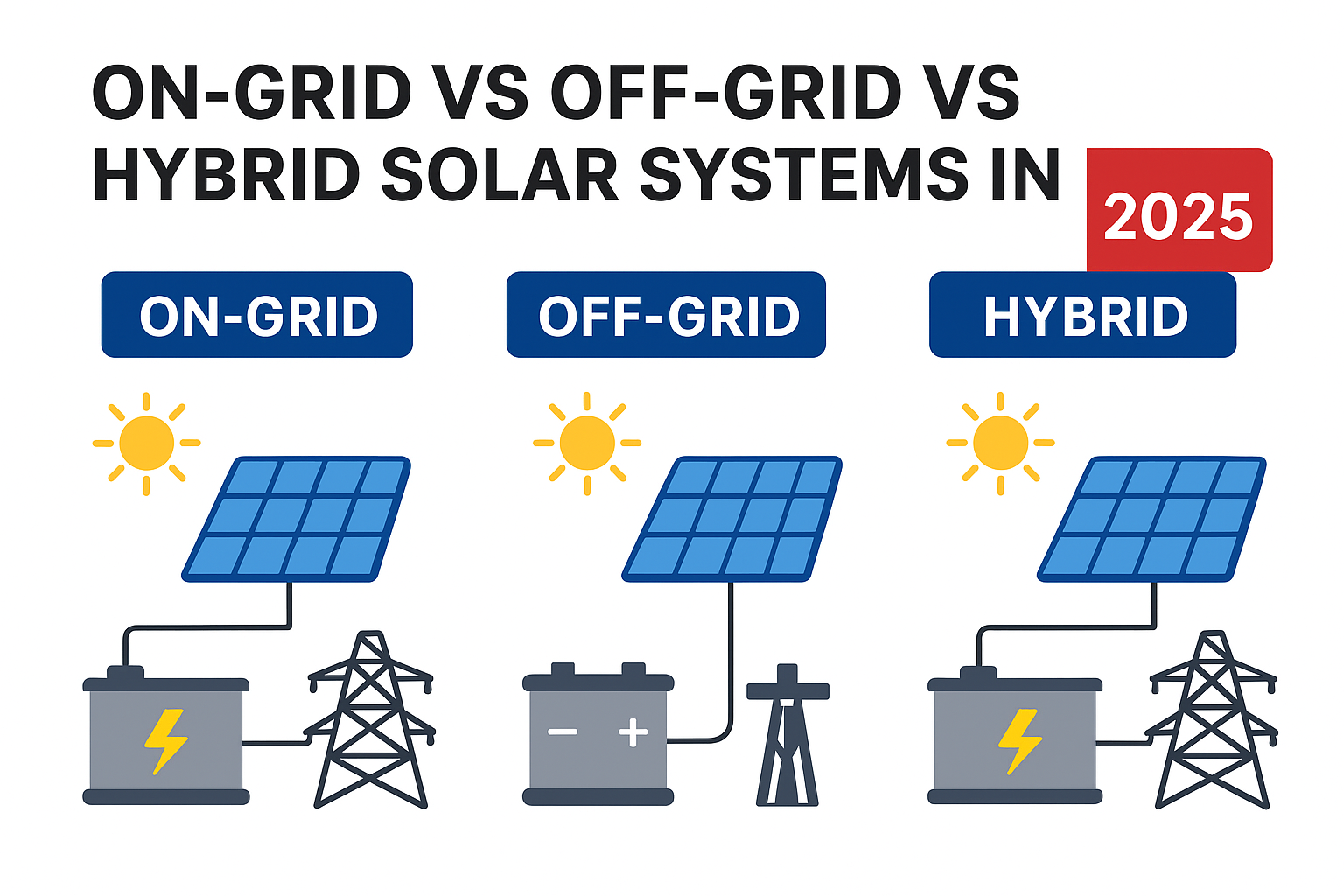
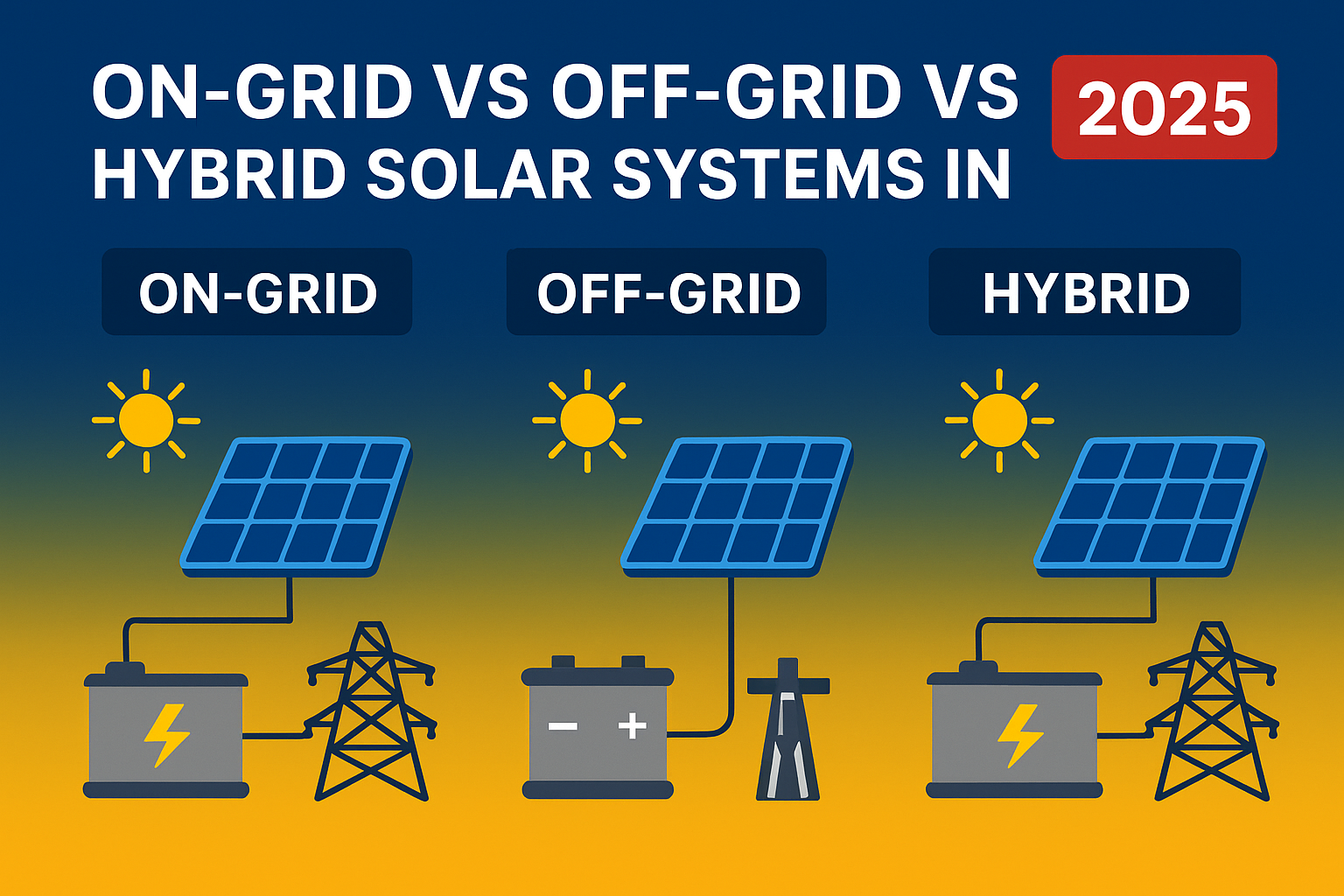
✔ On-Grid Solar System
Connected to the government electricity grid.
✔ No batteries
✔ Gives maximum savings
✔ Best for areas with good electricity supply
✔ Eligible for solar subsidy
✔ Off-Grid Solar System
Works independently without the government grid.
✔ Has batteries for backup
✔ Best for remote or low-electricity areas
✔ Low monthly savings but full independence
✔ Hybrid Solar System
A smart combination of On-Grid + Off-Grid.
✔ Works with grid + battery
✔ Gives savings + backup
✔ The most advanced system in 2025
✔ Ideal for Indian homes & commercial spaces
These definitions set the foundation for choosing the best solar system in India based on your real needs.
On-Grid Solar System in India (2025 Guide)
Keyword focus: on-grid solar system India, grid-connected solar 2025
An on-grid solar system is the most popular system in India because it provides the highest financial benefits with the lowest investment.
How On-Grid Solar Works
- Solar panels generate electricity
- Electricity powers your home
- Extra electricity goes back to the grid
- You receive credits (Net Metering)
Top Benefits
✔ Lowest cost solar system
✔ Highest ROI (4–5 years payback)
✔ No-maintenance system
✔ Supports net-metering (earn from extra energy)
✔ Ideal for homes, offices & factories
Drawbacks
✘ No power backup
✘ Stops working during power cuts
✘ Not suitable for rural areas with frequent outages
Best For
- Homes with stable electricity
- Businesses with high daytime load
- Residential apartments
- Shops & clinics
Off-Grid Solar System in India (2025 Guide)
Keyword focus: off-grid solar system India, solar with battery backup India
An off-grid system works 100% independently, meaning you don’t need any government electricity connection.
How Off-Grid Works
- Solar power is generated
- Battery stores extra power
- You use stored energy at night or during outages
- No dependency on the grid
Top Benefits
✔ Full backup during power cuts
✔ Independent solar solution
✔ Ideal for remote or low-power areas
✔ Saves you from voltage fluctuations
Drawbacks
✘ Highest cost due to batteries
✘ High battery maintenance
✘ Not eligible for on-grid subsidy
✘ Lower ROI compared to On-Grid
Best For
- Villages
- Remote locations
- Farms
- Shops with frequent outages
- Areas without net-metering approval
Hybrid Solar System in India (2025 Guide)
Primary Keyword Focus: hybrid solar system India, hybrid solar system 2025
A hybrid solar system is the future of solar in India.
It offers the savings of on-grid + backup of off-grid.
How Hybrid Solar Works
- Solar panels generate electricity
- Priority: Supply home appliances
- Next: Charge battery
- Extra: Export to grid (Net Metering)
- During power cuts: Battery supplies power
Top Benefits
✔ Power backup + Net metering
✔ Lower electricity bills
✔ Works during power cuts
✔ Best ROI + Best reliability
✔ Smart solar inverter technology
✔ Ideal for homes & commercial users
Drawbacks
✘ Higher cost than on-grid
✘ More complex installation
✘ Not all states support hybrid net-metering policies (changing rapidly in 2025)
Best For
- Homes needing backup
- Businesses needing uninterrupted power
- High-load commercial spaces
- Small industries
- Hospitals, labs, data centers
On-Grid vs Off-Grid vs Hybrid (2025 Comparison Table)
| Feature | On-Grid Solar | Off-Grid Solar | Hybrid Solar |
|---|---|---|---|
| Backup | ❌ No | ✔ Yes | ✔ Yes |
| Net Metering | ✔ Yes | ❌ No | ✔ Yes (in most states) |
| Cost | Low | High | Medium-High |
| Maintenance | Very Low | Medium-High | Medium |
| Best For | Savings | Backup | Savings + Backup |
| ROI | Highest | Medium | High |
| Battery | No | Yes | Yes |
| Works in Power Cut | No | Yes | Yes |
| Government Subsidy | Yes | No | Yes (if grid-connected) |
This comparison is crucial for ranking under “on-grid vs off-grid 2025” searches.
Which Solar System Is Best for You in 2025?
(Direct Answer Section — SEO Boost)
If your priority is maximum savings →
👉 On-Grid Solar System (Best ROI)
If your priority is power backup →
👉 Off-Grid Solar System (100% independence)
If your priority is savings + backup together →
👉 Hybrid Solar System India is the best option in 2025
The demand for hybrid solar is growing rapidly across India because electricity rates & outage frequency are increasing.
Cost of On-Grid, Off-Grid & Hybrid Solar Systems in India (2025 Prices)
Keyword focus: solar cost India 2025, hybrid solar price India
➤ On-Grid Solar Price (After Subsidy)
₹45,000 – ₹55,000 per kW
➤ Off-Grid Solar Price (With Battery)
₹85,000 – ₹1,35,000 per kW
➤ Hybrid Solar Price
₹95,000 – ₹1,50,000 per kW
This section improves ranking for keyword variations like “solar system cost India”.
Which Solar System Has the Best ROI in India?
- On-Grid – 4 to 5 years (Best)
- Hybrid – 5 to 7 years
- Off-Grid – 7 to 10 years (Depends on battery replacement)
Government Subsidies for On-Grid & Hybrid Solar (2025 Update)
The Indian government offers subsidies under PM Surya Ghar Yojana, making solar more affordable.
Subsidy applies to:
✔ On-Grid Solar
✔ Hybrid Solar (if grid-connected)
Subsidy does NOT apply to:
✘ Off-Grid Solar (battery-only)
Hybrid Solar System India – Why It Is Becoming #1 in 2025
Hybrid solar systems are trending for many reasons:
✔ Power cuts increasing
✔ People want savings + backup
✔ Smart hybrid inverters becoming affordable
✔ New Lithium batteries lasting 10–12 years
✔ Best long-term solution for urban households
If you are confused between on-grid vs off-grid vs hybrid in 2025 — hybrid usually wins for Indian conditions.
Final Recommendation (Direct Answer for SEO)
If you have stable electricity → Choose On-Grid
Maximum savings
If you face frequent power cuts → Choose Hybrid
Backup + savings
If you live in remote areas → Choose Off-Grid
Complete independence
Conclusion: Which Solar System Is Best for You in 2025?
The Hybrid Solar System in India is the best overall choice in 2025 because it gives:
✔ Savings
✔ Backup
✔ Smart energy management
✔ Long-term reliability
✔ Net-metering benefits
✔ Compatibility with future upgrades
If your goal is to get the most value from your solar investment in 2025, hybrid solar is the smartest and future-ready option.